The bird hangs on the wind above the ridge, wings bent back and tail twisting. Someone says red kite. Someone else says buzzard. Both are watching the same bird, and the disagreement usually comes down to whichever feature each of them noticed first.
A generation ago this argument barely existed. Red kites were confined to a handful of Welsh valleys, and almost any large brown raptor over a British field was a common buzzard. Reintroductions from the late 1980s onwards changed that. Kites now drift over towns, motorways and gardens across much of England, with growing numbers elsewhere, and they share the same airspace as buzzards. The two really do get mixed up.
The good news is that the confusion is easy to fix once you know what to look at, and in what order. Shape first. Behaviour second. Sound third. Plumage last — it is the least reliable clue of the lot.
Start with the Tail
If you take one thing from this guide, take this: the tail is the answer. Everything else confirms what the tail has already told you.
A red kite has a long tail with a deep fork, and it uses it constantly, twisting and tilting it like a rudder as it steers. Even when the tail is half-closed you can see how long it is relative to the body, and the fork is usually obvious from below, from above and from the side.
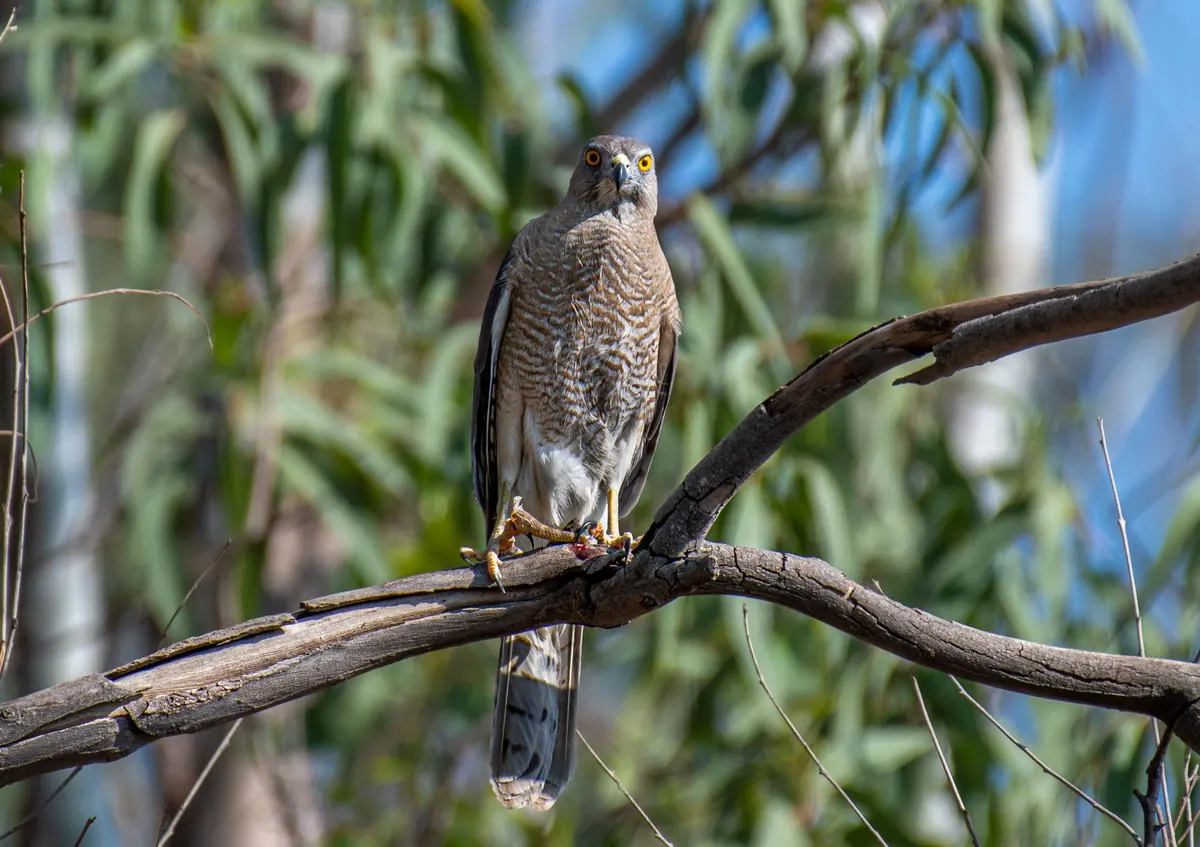
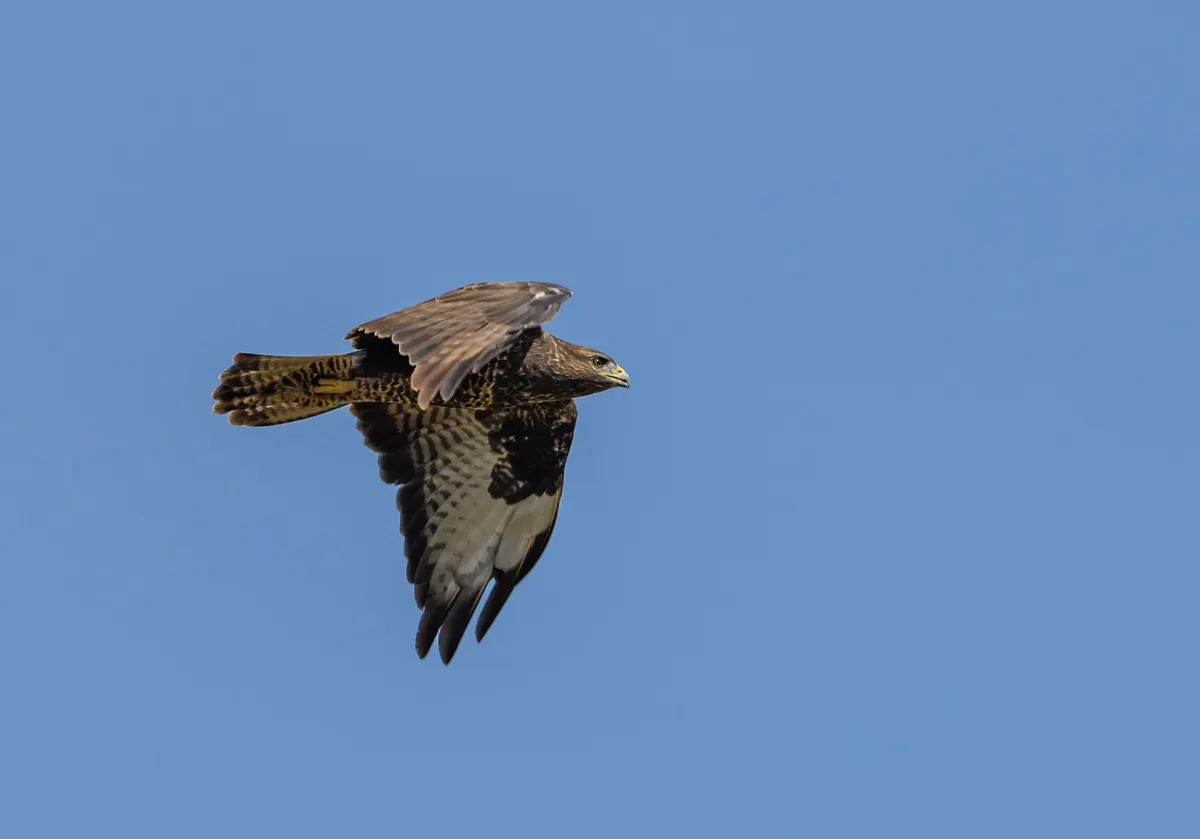
A buzzard's tail is short, broad and fan-shaped. There is no notch in it at all. When a buzzard spreads its tail to brake or to soar, it looks like a hand fan pushed out flat behind a compact, chunky body.
One caveat: young red kites in their first year have a shallower fork, sometimes just a small notch at the tip. Do not let that fool you. The tail is still long, the bird is still rangy, and the flight is still loose and buoyant rather than solid and deliberate.
Wings, Dihedral and That Bent-Wrist Look
Now look at the wings. A buzzard has broad, rounded wings with a noticeable bulge along the trailing edge, held in a shallow V when it glides. It looks like a bird built for carrying weight — and it is. The head sits close to the shoulders, the neck looks thick, and the whole silhouette is compact.
A red kite's wings are longer, set further back and angled at the wrist, so the leading edge shows a distinct kink rather than a smooth curve. In a glide the wings are often held in a pronounced dihedral, raised well above the horizontal. The body looks slimmer between them, and the pale head gives the bird a small-headed, almost gull-like profile. The wingtips droop and splay more, too.
How much does size help?
Red kites are genuinely bigger birds, with a notably wider wingspan, and an adult kite alongside a buzzard is not a difficult call. But judging size at distance is unreliable, especially against blank sky. A large female buzzard overlaps a small male kite. Use size as confirmation, never as your deciding feature.
Plumage: What to Check Once the Shape Has Convinced You
Buzzards are famously variable. Pale birds, dark birds and everything between occur in the same county, so never identify one on colour alone.
- Red kite, adult: pale grey head and nape, rich reddish-brown body, a white patch on the outer underwing next to the black wingtips, and a dark trailing edge. From above, the upperwing often shows a pale panel across the coverts.
- Red kite, tail: warm rufous, often paler towards the outer feathers, with darker barring.
- Common buzzard: dark carpal patches — the dark blobs at the bend of the underwing — are the single most useful plumage feature, usually clear even on distant birds.
- Common buzzard, body: brown and mottled, frequently with a band of darker streaks across the belly, and a short, broad, dark-barred tail with no fork.
- Watch out for: pale buzzards with whitish underwings, which get called kites every spring. If it has dark wrist patches and a fan tail, it is a buzzard.
Flight Action and Behaviour
Buzzards are unhurried and powerful. Their wingbeats are slow and deliberate, they glide on stiff, flat-ish wings, and they will spend an hour circling a thermal without appearing to hurry. They also like a perch: fence posts, telegraph poles, dead branches and gateposts. A large raptor sitting quietly on a post in a field is almost always a buzzard.
Red kites look loose in comparison. They are buoyant and languid, gliding with an easy, rubbery flexibility, correcting constantly with the tail rather than holding a rigid line. They quarter low over verges, farmland and rooftops, drop onto carrion, and rarely sit in the open for long. A kite hanging over a motorway or a housing estate is behaving exactly as you would expect.
The Call: Two Different Mews
Buzzards give a drawn-out, plaintive, cat-like mew, often repeated while soaring — a sound that carries a long way and is regularly mistaken for a kite by people who have not heard both.
A red kite's whistle is thinner, higher and slightly reedy, with a quaver in it, and it is usually shorter. It is often given in flight when birds are interacting over food. Plenty of kite sightings come with no sound at all, so never wait for a call before deciding. And be honest with yourself: a distant buzzard can sound remarkably thin. Trust the shape over the sound.
Putting It into Practice
Next time a raptor appears overhead, run through the same four checks in the same order. It takes about ten seconds and it works.
- Tail first. Long and forked, or short and fan-shaped?
- Wing angle. Bent at the wrist with a raised dihedral, or broad, rounded and held in a shallow V?
- Head and underwings. Pale grey head with white outer underwings, or a brown head with dark wrist patches?
- Behaviour. Buoyant, drifting and low, or steady, powerful and often perched?
Give every bird five seconds more than you want to. Kites rarely hold a straight glide, and a buzzard will often turn just enough to show you its tail — the one feature that settles the identification beyond argument.
Practise on the easy ones. If you have buzzards near you, watch them until the shape is fixed in your head: the thick neck, the shallow V, the fan tail. Then, when a kite turns up over the same ridge, the difference will be obvious before you have raised your binoculars. Photographs help, too; a single frame showing the tail is worth a dozen of a bird against blank sky.
Photo: Petr Ganaj / Pexels